
Every Crane Hoist lifts with wire rope, and the way that rope is threaded through the drum, the sheaves and the hook block is called reeving. It decides how much load each rope carries, how fast the hook moves and how the rope wears. This guide explains it in plain words, for the people who own, operate and maintain EOT Cranes, Gantry Cranes and Hoists.
What reeving means
The rope starts on the drum. It runs down to the hook block, round a sheave (a grooved wheel) in the block, back up to a sheave or to the drum, and so on, until the last part is fixed at its end. The fixed end is the dead end. The rope path is the reeving.
The parts of a reeving system
- Drum: the grooved barrel that winds the rope in and pays it out.
- Wire rope: the working part that carries the load.
- Sheaves: grooved wheels that guide the rope. Those in the hook block move with the load. Those in the head frame stay fixed.
- Hook block: the lower block that carries the sheaves and the hook.
- Dead end and anchor: where the rope end is fixed, for example with a wedge socket.
- Equalizer sheave: used in some Hoists, it balances the rope between its two sides and keeps the hook block level.
Parts of line: the number that matters
The parts of line are the rope sections that hold up the hook block. If four rope sections carry the block, the Hoist is reeved with four parts of line. The load is shared between them, and the hook moves more slowly than the rope winds onto the drum.
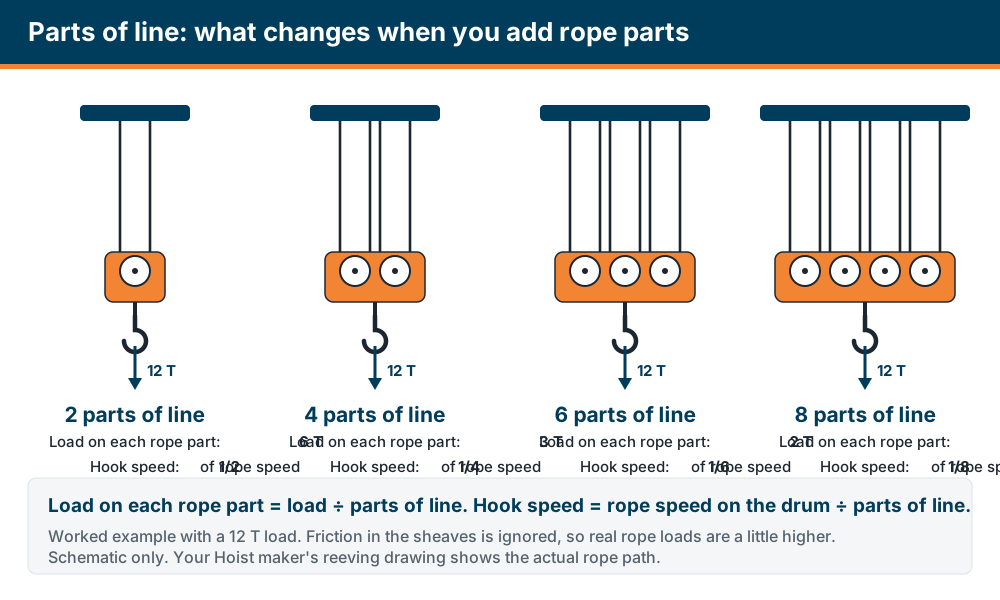
| Parts of line | Load on each rope part (12 T example) | Hook speed | Rope wound on the drum for the same lift |
|---|---|---|---|
| 2 | 6 T | 1/2 of the rope speed | 2 times the lift |
| 4 | 3 T | 1/4 of the rope speed | 4 times the lift |
| 6 | 2 T | 1/6 of the rope speed | 6 times the lift |
| 8 | 1.5 T | 1/8 of the rope speed | 8 times the lift |
The rule is simple: load on each rope part equals the load divided by the parts of line. Friction in the sheaves adds a little to this, so real rope loads are somewhat higher than the table shows.
Why a Hoist uses more parts of line
- A lighter load on each rope. A heavy lift can use a smaller rope when it is shared across more parts.
- Smoother, finer control. A slower hook is easier to position under load.
- The trade-off. More parts of line need more rope, more sheaves and a longer drum, and every extra sheave adds bending and friction. The Hoist maker balances these for the capacity, the lifting height and the duty.
Check these at every inspection
- Rope on the drum: it should lie in the grooves, in turn, without crossing, riding up or bunching.
- Dead turns: with the hook at its lowest position, the maker's minimum number of turns must stay on the drum, usually at least two. Never let the rope run out to its last turn.
- Dead-end anchor: the wedge socket or clamp is fitted as the maker shows, with the rope tail secured as instructed.
- Sheaves: they turn freely, the grooves are smooth and the rope is not worn into a groove that is too tight or too wide.
- The rope itself: look for broken wires, kinks, flattening, corrosion, loss of diameter and dry, rusty patches. Discard the rope when it reaches the limits in the maker's manual or in a recognised standard such as ISO 4309.
- Twist: the hook block must hang straight, with the ropes untwisted.
When you change a rope
- Use a rope of the diameter, construction and grade the Hoist maker specifies. A rope that looks similar can behave differently on the drum.
- Match the rope lay to the drum winding direction, as the drawing shows.
- Reeve with the hook block resting on the ground and the rope free of twist, and seat the rope on the drum without crossing.
- After the change, run the Hoist unloaded, then with a test load, before it goes back into service. Your competent person will advise on any test the statutory rules ask for.
How we help
We service Cranes of any make and age. As part of a health check or an AMC, our engineers inspect the rope, sheaves, drum and dead-end anchor, report what they find and plan a rope change at your next shutdown. Send us the make, capacity and location of your Hoist.
Frequently asked questions
- What are parts of line?
- They are the rope sections that carry the hook block. The load is shared between them, so more parts of line mean less load on each rope.
- Why does the hook move slower with more parts of line?
- The drum winds in several parts of rope for every unit the block rises, so the hook speed equals the rope speed divided by the parts of line.
- What is the dead end of a wire rope?
- It is the end that does not wind on the drum in the working reeving. It is fixed with an anchor such as a wedge socket. Some Hoists wind both rope ends on the drum and pass the rope over an equalizer sheave instead.
- Can I change the reeving of my Hoist to lift a heavier load?
- No. Reeving is part of the Hoist design, together with the rope, drum, sheaves and brake. Changing it needs the maker's approval and a fresh load test.
- When should the wire rope be replaced?
- When it reaches the discard limits in the maker's manual or a recognised standard, for example for broken wires, wear, kinks or corrosion. Do not wait for a failure.