
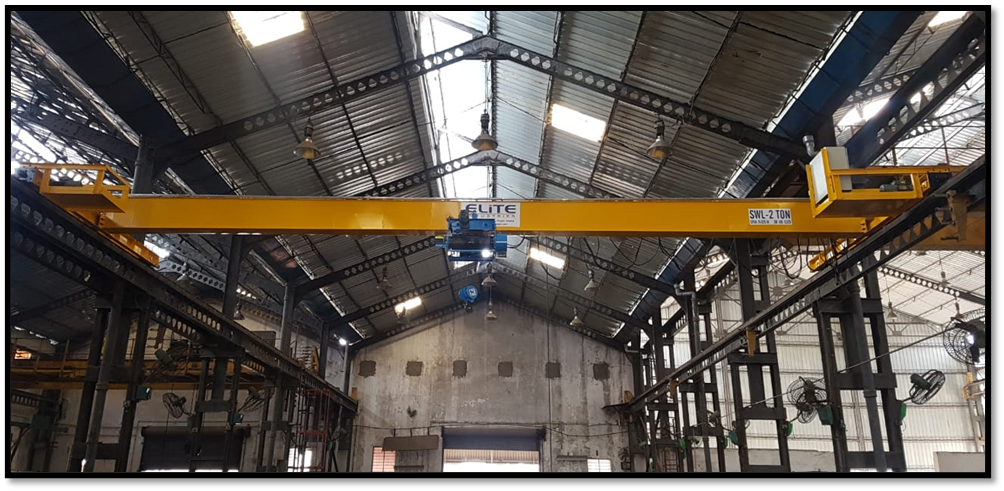
An electric overhead travelling (EOT) Crane runs on rails along the sides of a bay and lifts with a Hoist that moves across the bridge. The bridge can have one girder or two. The choice sets the Crane's capacity range, its hook height, the load it puts on your building and the way you will maintain it. This guide gives the points to check before you decide.
What is different
Single Girder. The Hoist hangs from the lower flange of one girder. The Crane is lighter, so runway beams and columns carry less load. Fewer parts mean simpler inspection. The hook sits lower than on a Double Girder of the same span, because the Hoist is under the girder.
Double Girder. The trolley, with the Hoist or Hoists, runs on rails on top of two girders. The hook can rise higher, close to the roof. The structure is stiffer, so it suits long spans and heavy loads. It also has room for a main and an auxiliary Hoist, a walkway and a cabin.
Five checks
- Capacity and duty. Light to medium duty and moderate capacity point to Single Girder. Heavy duty, continuous use, high capacity or critical lifts point to Double Girder. The duty class under IS 3177 describes how often and how heavily the Crane lifts. Choose by duty class, not just by the weight of the heaviest load.
- Headroom and hook height. Measure from the rail top to the underside of the roof truss. If the building leaves little headroom, a Single Girder or an Under-slung Crane may fit; if you need the highest hook or the closest hook approach, a Double Girder gives more.
- Span. Long spans favour Double Girder because of its stiffness. Our DG Cranes go up to 40 m span.
- Building and runway. A lighter Crane means lighter runway girders. If you are adding a Crane to an existing shed, have the structure checked first.
- Future needs. If capacity or duty may rise, a Double Girder gives room to add an auxiliary Hoist, a cabin or higher speeds. A Single Girder can be hard to uprate.
Where each is used
Single Girder Cranes are common in workshops, stores and assembly bays. Double Girder Cranes are the norm in power houses, steel shops and foundries.
Maintenance
Single Girder Cranes have fewer components and are quicker to inspect. Double Girder Cranes have more to check but also more room to work safely on the trolley. Whichever you choose, plan a yearly inspection and statutory load test; see "How often should a Crane be inspected?".
What to send us for a recommendation
Capacity of the main and auxiliary Hoists, span, hook path, runway length, indoor or outdoor, lifts per hour, typical and maximum load, speeds, control (pendant, radio remote or cabin), power supply and site location.
Frequently asked questions
- Is a Single Girder always cheaper?
- Usually it needs less steel and a lighter runway. The right answer depends on duty. A Crane that is too light for its work costs more in repairs.
- Can a Single Girder Crane be fitted with a cabin?
- It can be, but Double Girder Cranes handle it more naturally. Tell us your need and we will advise.
- What is the maximum capacity you build?
- Up to 300 T.
- Can you service a Crane we already own?
- Yes, any make.